At Sceye, our story began with a question: what if we could bring the power of space technology closer to Earth to help people and the planet?
Our founder, Mikkel Vestergaard Frandsen, spent two decades building companies in material science creating life-saving products in safe drinking water, food security, and public health with his companies Vestergaard® and LifeStraw®. His work in material science led him to NASA and USAID’s Launch Council, an advisory group that explored how space innovations could improve life for people in underserved communities. There, he was introduced to the bold idea of putting a platform at the edge of space not to look up to the stars, but back down, to improve life on Earth.
The stratosphere exists about 20 kilometers above Earth. There is manageable wind, it’s twice as high as commercial air traffic, and it’s 95-97% of the way through the atmosphere – meaning the stratosphere offers space-like conditions without the cost and complexities of being in space and the disadvantages of being in orbit. But, building something that could stay in place below orbital altitude was long considered the holy grail of aviation. For decades, others had tried and spent billions, only to fall short.
The Sceye team studied those earlier attempts to understand what went wrong. It boiled down to two things: materials and process. Advances like the discovery of graphene for hull fabric and next-generation batteries allowed our team to dramatically reduce weight while improving strength and performance. And rather than rushing straight to prototype, we embraced iterative development – building, flying, learning, and improving with every flight.
A decade of iterative development
Sceye’s success in the stratosphere is the result of 10+ years of disciplined, iterative development that continues to leverage evolving innovations in material science while focusing on optimizing performance relative to weight. In total, we’ve flown 20+ times.
Between 2016 and 2021, we scaled our HAPS, enabling greater capacity and increased altitude with each flight.
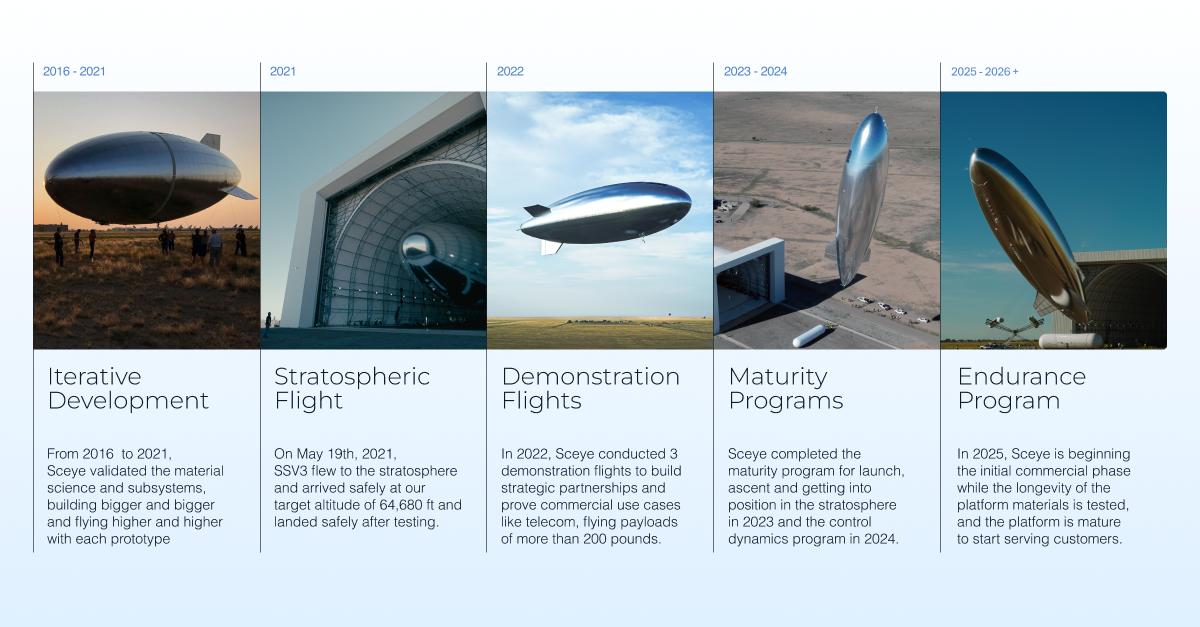
In 2021, we reached our target altitude in the stratosphere for the first time, proving that sustained, stable flight was possible.
From there, our focus shifted to demonstrating real-world applications. In 2022, we completed a series of flights with partners including the U.S. Department of Transportation, the Navajo Nation, and América Móvil, proving our HAPS’s ability to deliver connectivity out to 140km direct to smartphone within FCC-defined broadband thresholds.
In 2023 and 2024, we focused our testing program on maturity, including launch programming, ascent, positioning in the stratosphere, and control dynamics. On August 16, 2024, we achieved a major milestone of closing the power loop and maintaining controlled flight over an area of operation for a full diurnal (day+night) cycle. The holy grail was achieved.
By 2025, Sceye entered its pre- commercial phase, testing and pushing platform endurance, and longevity. And now, in 2026, we’re finishing our endurance program and preparing for pre-commercial operations, starting with a telecom test flight in Japan later this year in partnership with SoftBank Corp. Our goal is to successfully provide a backhaul connection into SoftBank’s core network.
Over the years, each flight has brought us closer to what was once thought impossible. Our commitment to science and iterative learning – to testing, validating, and innovating – has been the key to unlocking the stratosphere and building a new layer of infrastructure to improve life on Earth.
HAPS are no longer just a great idea – they are real. And the stratosphere is open for business.